Kendra Pierce
Nathan Reynolds
Mind, Machine, Consciousness
LE-1310-401
March 2, 2015
Evolution and Workforce of Robotics
As we look back through history and see the incredible amount of change that has taken place, there is one thing in particular that out weighs all else and that is technology. As the world we know rapidly revolutionizes into a world of technology, innovations, and computer driven lifestyles, we see that what we once thought impossible is possible. This opens the lines for expansion and forward progression and has created an avenue for artificial intelligence to reach its full potential. The history and evolution of robotics has brought many to believe AI entitles will not only exist in the near future, but could eventually take over our workforce.
The history of Robotics dates back to 1495 when Leonard Di Vinci designed the first humoid Robot. The word Robot however, did not originate until 1921 when a Czech dramatist Karel Capek used it to describe mechanical like people that were acting in the play “Rossum’s Universal Robots” (“Robotics”). Over the next forty years progress creating each part was slowly starting to evolve. In 1950 Alan Turning created the now famous “Turing Test”. He proposed this idea through the book he published, Computing Machinery and Intelligence. This was an annual challenge directed at software designers in order to decipher how close they had become to creating the Turning Machine. In 1961 General Motors installed the first industrial robot. The robotic arm, known as Unimate weighed an incredible 4,000 lbs. and held the primary role of stacking and sequencing hot metal die casts (“Robotics”).
Fast-forward 54 years to our current day and the progress that has been made in the robotic industry is astronomical. Humans are steadily increasing the avenues in which robots are used. This can be anywhere from military use and space explorations to production/manufacturing and use in the medical field. The list is quite extensive and will continue to grow as technology rapidly progresses. According to the International Federation of Robots, sales have increased by 38 percent in 2011 alone. Furthermore, the world wide stock of robots is approximately 1,153,000 – 1,400,000 units (Berlinger 2012).
With rapid increase in robotic use, some are slightly alarmed that robots will one day take over the human workforce leaving most without means to provide for themselves and their families. This topic is highly controversial and with numbers recorded as reflected below, it is very understandable why some may be concerned.
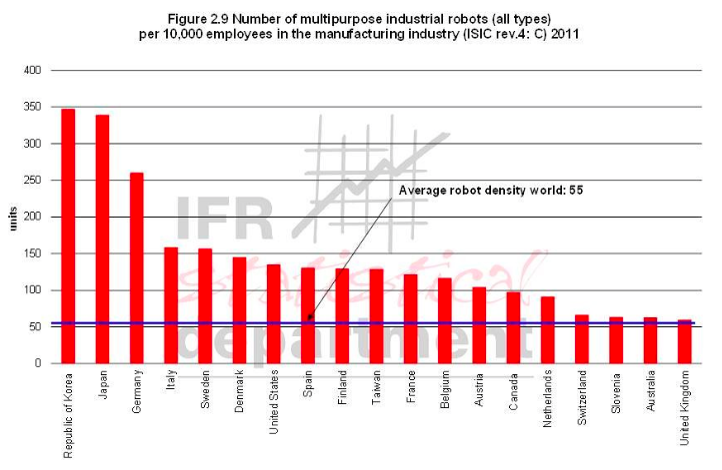
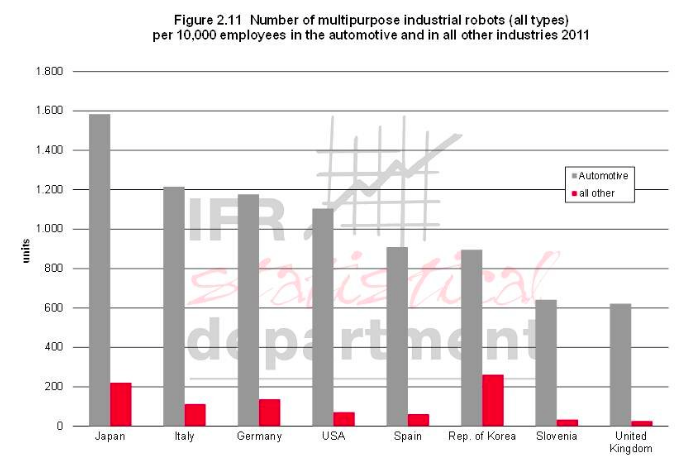
(Berlinger, 2012)
According to Gartner, one of Americas leading information technology research companies, by 2025 smart robots will have taken over one third of jobs. Author of The Second Machine Age, Erik Brynjolfsson states:
“In recent years, we are seeing a wave of technologies that can augment, automate all sortsof cognitive tasks,” he added.“ and we think, ultimately, those will have as big, or an even bigger effect on humanity as the first industrial revolution.”
This of course, can be argued on both sides but the reality is that it all comes down to this one question; Would the benefit outweigh the negative if, robots could function an a high enough level that they would eventually take over the workforce? Just like everything else, there are pros and cons to this decision.
According to Phil for Humanity, the most obvious advantage would be the cost. Robots would be cheaper to buy and fix when needed, then humans would be to employ. Productivity also weighs in as a benefit since robots can work long hours and do not need breaks or tire down they are able to get more work done then humans. Robots are programmed to complete each task with absolute precision. Once given an order they have the abilities to execute that order in the exact same fashion each time. This is especially usefully in production lines where things need to be measured, weighed, counted, and so on. Robots are also made to be much stronger and faster then humans ever could. Environmental factors also need to be considered when weighing out the benefits. Because robots are machines, they can be made to withstand environmental factors such as freezing cold temperatures, fire, water, limited air supply and so on, that humans can not. This allows them to perform some of the more dangerous work and could potentially save some lives in the process.
In my opinion, the most common negative to utilizing robots would be that they would take over a large number of jobs, leaving people in hardship. Another factors to consider would be their lack of emotion, conscious, functionality and intelligence. They are programmed to operate in certain ways and anything outside of that is obsolete to them. Therefore, when a situation arises that needs a quick decision the robot is unable to process the most beneficial route. Also, because they are programmed to follow orders and commands this could lead them to become very dangerous. Because they lack emotion, conscious, intelligence and functionality it would be impossible for these artificial intelligence entities to understand the programming they have been given is harmful or dangerous.
There are many more underlying factors that I have not addressed. However, just as we have seen over the last several hundred years, times are changing. The impossible becomes possible and the far future gets closer and closer with each passing day. We need to be prepared to deal with artificial intelligence as we watch it transform right in front of our eyes.
Bibliography
- Barajas, Joshua. JB. “Smart Robots will take one third of Jobs by 2025” <http://www.pbs.org/newshour/rundown/smart-robots-will-take-third-jobs-2025-gartner-says/>.
- Berlinger, Joshua. JP. 2012 "These Are The Countries Where Robots Are Taking Over." http://www.businessinsider.com/countries-where-robots-are-taking-over-2012-12
- “Robotics History Timeline”. <http://robotics.ece.auckland.ac.nz>.
- "The Pros and Cons of Robots. "<http://www.philforhumanity.com/Robots.html>.
What impact did the assignment make on your understanding of future applications of AI in the world we live in?
This assignment has really helped me understand the depth and rapid growth of Robots in the world we live in. Prior to this assignment when I though robots I thought only of human like robots that have been portrayed through books and film. However, after completing this assignment I see now that robots are used all around us. There benefits could easily out weigh the negative although there is reasonable argument in both. With the rapid growth and benefit we have seen in robotics this far, leads the possibilities for future application increasingly plausible.
In what way did your study for this paper challenge any of your assumptions?
Prior to completing this paper, I was under the impression that robots would be more harmful to our world then helpful. Through the research I have completed over the course of this class and for this paper, I have gained a better understanding of the true benefit of robots. It was challenging to put my pre conceived ideas and beliefs to the side and really open my mind up to the possibilities of Artificial Intelligence. Since doing so, I am very interested in seeing the possibilities of advancement in the robotics world and watching them unfold before our very eyes.
